You can't scale what you can't see coming.
So you reach for more: more spend, more products, more channels, a bigger return. But the dashboard you steer by is a good indicator, never the source of truth, the account is so busy the noise buries the signal, and the team running it was built to handle many accounts, not to see around your next corner. We make the numbers true, trim the waste, and move the budget to what actually works, so more compounds instead of leaking.
The store grows, the waste stacks with it, and nobody can tell you what happens next.
You built something real and you're not standing still: you spend, you test, you ship new creative, you're probably growing right now. None of that is reckless, and you're not bad at this. The trouble is the view. Past the ad dashboard, inefficiencies quietly stack on top of each other, and the next corner, inventory, a season, a platform rule change, stays invisible until it has already cost you.
However you got here, the picture is usually one of three.
Maybe the dashboard says every campaign is profitable and your accountant says the quarter was a loss, and the last agency's report was green arrows all the way down. Maybe the store is genuinely growing and you can feel waste riding along in the numbers, but you can't point to where. Or maybe your product is made to order and closes on a phone call worth tens of thousands, and the open question is which ad that call actually came from.
All three are the same problem wearing different clothes. The ad dashboard doesn't see returns, cancellations, the upsell flow, or what a customer is worth over a year, so the number you steer by drifts away from the money that lands. A dashboard is a good indicator, and it was never the source of truth. The question that matters is where the delta is: what sits between the number on the screen and the number at the bank.
And the busier the account gets, the worse the view. Underneath it all sits the part no report shows you: whether a single sale makes money before you spend to get it, which corner is coming next, and whether anyone running your account was ever taught to scale deliberately instead of just spending.
Speed without visibility doesn't get you there sooner. It just decides how hard you hit what you couldn't see.
Run everything at once and you haven't placed twelve bets; you've made one cloud of static where no single signal can be heard. The instinct when sales feel flat is to add another thing. But every new thing you add to a noisy account makes the one thing that's working harder to find, not easier. The first move is almost never more. It's quiet.
Before we optimize anything, we make the number true.
Most founders steer by the return the platform reports, and that's the right instinct pointed at the wrong number. The platform's version rarely survives contact with the bank, because returns, cancellations, and missing or sloppy attribution all bend it.
So the first thing we build is honest reporting. On one apparel brand we stood up a server-side tracking and attribution system that beat the platform's own so-called server-side version, which was still running a double-digit gap between what was reported and what actually happened. You can't prioritize what you can't trust. Truth in the numbers comes first, fast, and everything else gets built on top of it.
We don't just run your ads. We run a system.
The order is never fixed. It follows what your business needs. What never changes is the engine underneath the tactics, and the discipline that runs it: there's a methodology to testing, a methodology to scaling, and a methodology to maintaining. When something fails, we can tell you why and what it taught us. When something works, we know how to carry it into the next campaign instead of hoping it repeats.
The engine covers the whole life of a buyer, from the person who just found out you exist, to the one deciding what would carry them across the finish line, to the customer who reorders, brings friends, and shows the product in their own words. Each step gets its own attention, and the value added after the sale is built to feel natural, never like a funnel squeezing them.
The same engine runs a store with a fast checkout and a maker whose product is made to order and sold through a consultation, not a cart. If your sale closes on a call worth tens of thousands, you belong here too, and the corners we watch are yours.
Where this breaks Why your last agency couldn't see this coming. Your people are probably talented. The gap sits in the model.
Your people are probably talented. The gap sits in the model.
Your last agency wasn't acting in bad faith. An agency makes its money by handling as many clients as it can, so it's built to spread attention thin and run the same playbook on everyone. Efficient account management and deliberate scaling are rarely taught and almost never have time to happen.
We made the opposite choice. We keep a small number of accounts we know cold, around a dozen that stay for years rather than fifty managed from a dashboard, and we work like an invisible partner: making sure you see every opportunity, reasoning through what the performance is actually saying, and finding the better, faster move before the corner arrives. That's the whole difference between someone who runs your ads and someone who can see what's coming.
Where we look The next move is not always an ad. Here is everywhere we look. Sometimes it's the positioning. Sometimes the email flow you never built, or the affiliate program, or the way an upset customer is handled on the phone.
The next move is not always an ad.
We look everywhere the needle could be, because the thing holding back this quarter is often nowhere near the ad account. Sometimes it's the positioning. Sometimes it's the email flow you never built, or the affiliate program, or the way an upset customer is handled on the phone.
- Positioning & branding
- Messaging
- Customer experience & upset customers
- Email & SMS
- Affiliates & partnerships
- Turning customers into ambassadors
- New channels
- Inventory & supply
- Sale events & intelligent discounting
It's also why a store doesn't need a checkout to belong here. One client sold a made-to-order product worth tens of thousands through an ad, then a phone consultation, then a close. The needle there was the positioning and the way the call was handled as much as the ad that started it. Whatever moves your business forward next, that's the thing we work on, in the order that pays.
Restricted category If your category is policed, a rule is a bridge, not a wall. The strongest true thing about your product is often the one the rules forbid you to say.
A platform rule is a bridge to build, not a wall to stop at.
Supplements, wellness, anything a platform watches closely: the strongest true thing about your product is often the one the rules forbid you to say, so the page goes quiet exactly where it should be loudest. That's a translation problem, and it has a known fix. Move the strongest message into the channels they don't police, like your own email. Translate the forbidden claim into the defensible one that keeps the meaning. Build compliance in as infrastructure, so a ban becomes a speed bump instead of the end. A restriction you've prepared for is a moat, because most competitors never bother.
Beliefs Nine things we stopped arguing about. After enough stores, a few truths stop being opinions.
Nine things we stopped arguing about.
After enough stores, a few truths stop being opinions. If you only take these with you, the page did its job.
- More spend on a buried signal just buys more noise.
- An ad dashboard is a good indicator and never the source of truth: returns, cancellations, and lifetime value live outside it.
- You can't prioritize what you can't trust, so the reporting comes first.
- Promote everything at once and you've promoted nothing. The signal drowns.
- The biggest needle is rarely the ad. Sometimes it's the email, the positioning, or how you handle an upset customer.
- A team built to handle many accounts can't see around the corner of yours.
- Test, don't deploy. A hypothesis on a slice of budget beats a bet-the-quarter pivot.
- The hacks and tricks of the past don't translate anymore; if anything, they create greater waste. What your store signals to the AI engines matters more than ever.
- The strategy never changes: faster, more profitable growth with minimal waste. Only the tactics do.
Real e-commerce engagements, with the context most leave out.
No naked percentages. Each one shows the thing they walked in believing, and what the truth turned out to be.
A quick note on counting, because we keep a small book on purpose. Each case below is one diagnosis, one finding from one long engagement, not one client. A single account we've held for years produces many of these, which is why you'll see more findings here than we've ever had clients.
The cases above are single findings. These two follow one engagement all the way through, so you can watch what we saw, what we decided together, and what got built.
See which of your own campaigns actually pay, and the corner ahead you can't see yet.
Start with a conversationMore proof Four more store diagnoses, in their own words. “Only one in three orders had money behind them.” “The ten-thousand-dollar video lost to a free photo.”
Representative engagements, de-identified. Figures reflect specific client work and are not a promise of similar results. Every business is different.
You can run this on yourself right now.
A business you can see around the corners of, and one day sell.
Lower waste and a higher return are how you keep score, and you'll get them. But the point is bigger. The same work turns the store into an asset that grows in value for more than its revenue, because the systems and processes underneath it are worth money too. They mean the business runs on a plan that gets executed consistently, by a team you trust, whether or not you're in the room.
What that looks like Where a dollar spent returns a dollar you can find. A real vacation without checking your phone at the pool. The valley seen in time to fund through it, the peak in time to stock for it.
It looks like this: you take an actual vacation and the phone stays in the bag. The valley shows up in time to fund through it, the peak in time to stock for it, and a dollar spent returns a dollar you can find. The plan is written down, the team you trust is executing it, and you know what happens next before it arrives.
You built this to get somewhere. The fog shouldn't be the thing deciding how fast.
See the truth on your own numbers, and the corners ahead, before you spend another dollar.
Before more spend or new creative, the first move is making the reporting real and finding the move that pays the most for the least effort. Picture opening one screen and seeing which campaigns actually pay, where the wasted budget should go instead, and which corner would've caught you off guard. That's the difference between scaling on faith and scaling on fact.
The Second Opinion
We make your reporting true, then hand you a ranked list of the moves that pay, biggest impact for least effort first, plus the corners ahead to plan for. It's built for the founder and whoever runs the spend.
It starts with a free alignment call to make sure it's a fit. Then you book two working sessions on our calendar with the people who run the store in the room: you, whoever runs the spend, and whoever owns fulfillment. About a week after the final session you get the written diagnosis, walked through live on a third call so nothing is left to interpretation. Where the tracking doesn't exist yet, we build it, because nothing we recommend is worth more than the truth it sits on. The whole anatomy is on the how it works page.
Then you choose between four options: have us do the work for you, now or later. Do it yourself. Hand it to another agency. Or do nothing. The diagnosis is yours either way, and there's no agenda to sell you the build.
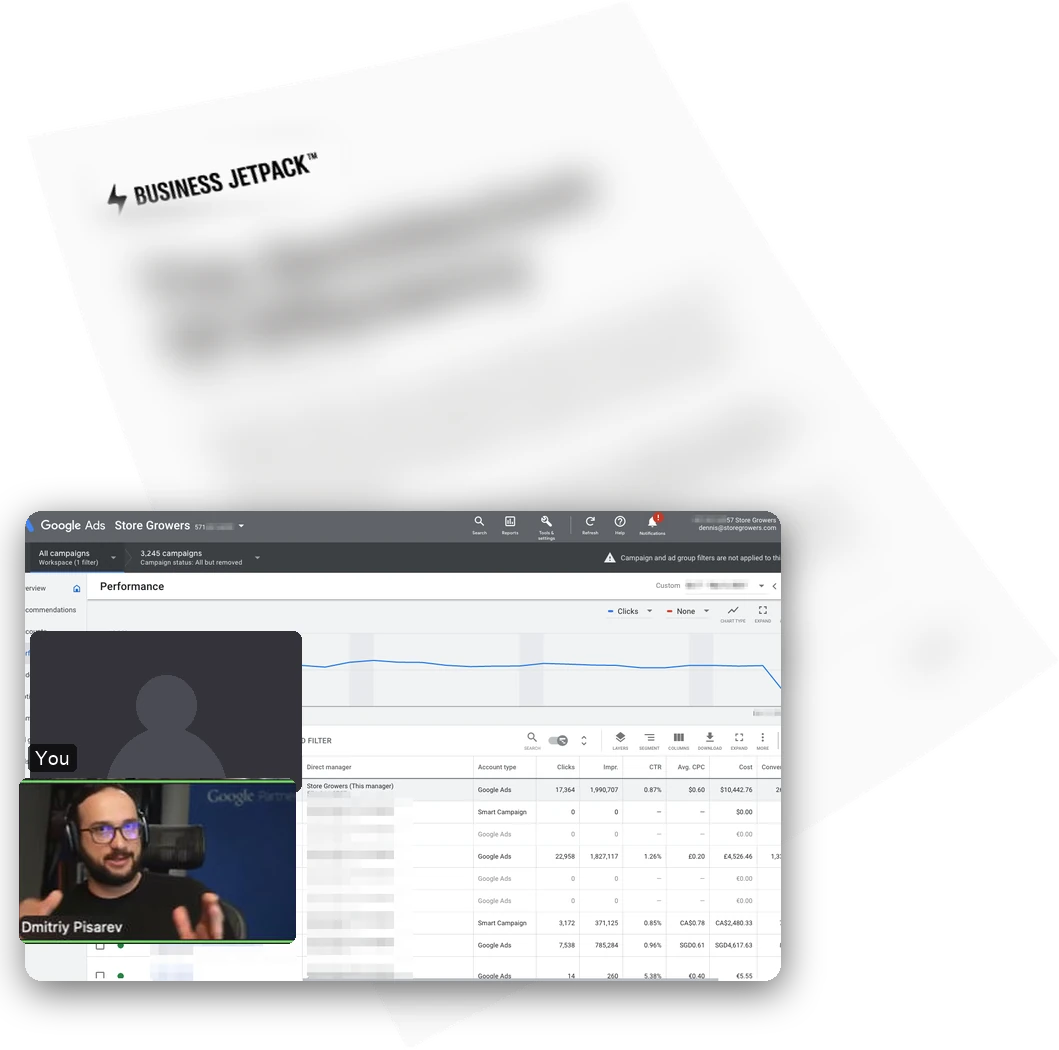
- Your reporting reconciled to what actually cleared, so the numbers are real.
- Where the waste is, and where that budget should go instead.
- A ranked list of moves, biggest financial impact for least effort first.
- The corners ahead to plan for: inventory, seasonality, channel concentration.
Same wall, different door.
We've cleared the same problem in other markets. The diagnosis is the same. The door is yours.
What founders ask first.
Isn't more spend the way to grow?
Only once the signal is clean and the number is true. Pour more spend into a noisy account on top of reporting that drifts from the bank, and you just buy more noise faster. We trim the waste, move the budget to what works, and make the reporting real first. After that, more spend compounds instead of leaking, and we can actually tell you how much more is worth it.
We already have a media buyer or an agency. Why you?
Your people are probably talented, and blame is nobody's point here. The gap sits in the model: an agency earns by handling as many accounts as it can, so it's built to spread thin and run one playbook. We keep a small number of accounts we know cold, around a dozen, because seeing around your corners can't be mass-produced. And the person who understands your full picture is the person doing the work. Your account never gets handed down to a junior team, the process is agreed on up front, and you don't have to babysit any of it.
Do you only do ads?
No. We work the whole life of a buyer, from the person who just found you to the customer who reorders and brings friends, and the thing holding back this quarter is often nowhere near the ad account. It might be the positioning, an email flow you never built, an affiliate program, inventory, or the way an upset customer is handled. We look everywhere the needle could be and work it in the order that pays.
We sell mostly on Amazon. Is this for us?
It depends on whether you own a store too. If the marketplace is one of your channels and you also sell on your own site, yes, that mix is exactly where the corners hide. If the marketplace is the whole business and there's no store of your own, we're honestly not the right fit, and we'd rather say it here. We've even told a client to stop paying us for store work when their marketplace was winning the numbers, and helped them capture those buyers into an audience they own instead. Dropshipping doesn't rule you out either: one client drop-shipped every made-to-order structure they sold, and the business we grew was the guidance their buyers actually paid for, the consultation that picked the right configuration. What matters is whether there's a business you own to build on.
What if I don't like what you find?
The truth sometimes shows the edges of a problem you haven't had to look at before, and that can be uncomfortable. This works best for the founder who's ready to act on what the numbers reveal. If the timing is wrong, we'll tell you, because we'd rather pause than take your money to paper over something you're not ready to face. That honesty is the whole point of starting with a diagnosis instead of a contract.
Can I even market a category the platforms police?
Yes. The rule almost never bans the marketing, it bans a specific claim. We move the strongest message into the channels the platform doesn't watch, translate the forbidden claim into a defensible one that keeps the meaning, and build compliance in as infrastructure so a ban becomes a speed bump instead of the end. A restriction you've prepared for is a moat, because most competitors never bother.
Stop buying more. Start seeing around the corner.
Start with a conversation. If it's a fit, the Second Opinion makes your numbers true and hands you a ranked list of the moves that pay, plus the corners ahead, on your own store, with the written diagnosis about a week after the final working session.
If we open your account and there isn't a clear, profitable next move worth more than the diagnosis, we tell you on the call, before you spend another dollar with us.